Blog

Cats and Oranges
On Oranges
Years ago, my wife and I attended a theater show where oranges were rolled onto a stage during a live performance. The actors, still thoroughly engaged in the story — dancing, moving, repeating their lines — struggled to avoid slipping on the oranges. Some, in fact, did, and when it happened, I burst out in laughter. I couldn’t help myself.
Well, my outburst wasn’t well received. Most of the audience turned to glare at me as if I was some Neanderthal who didn’t appreciate good art.

I use this story to illustrate the problem of art. A rolling orange can be one person’s serious artistic statement and another’s comedic moment. Art is entirely subjective, and what constitutes artistic expression isn’t up to us, but the judgment of our audience.
In the art of writing, we use the tools of our craft to relay a story to a reader.
We have nouns and verbs, adjectives and adverbs; we have intensifiers and modifiers. We have punctuation, sentence structure, and paragraph sequences. We have tools like flashbacks and flash-forwards. We have perspectives like 1st and 3rd person. We might tell more than show. We might have a story of one word, a hundred words, or a hundred thousand words. We strive for eloquence and brevity in our expression and, for some, capture universal themes of the human experience in our writing.
Oranges are our art. How well tell a story is the subjective choice we make as authors to relay how we feel it should be told. When someone judges our writing and experiences our art, they see it through a lens of their own personal experiences and biases. They might not like nor prefer the tools we used to tell it and may score us poorly. If anything, poor use of oranges may diminish our credibility in the eyes of readers, judges, and publishers.
On Cats
Cats, on the other hand. Everybody likes cats. People are obsessed with cats. People share cat pictures all day long. People love cats.

Cats are the bread and circus of writing — they’re stories readers want to read. A cat is what a reader expects when they read your story. Whether or not it’s a horror, romance, or adventure, readers have certain expectations about what that story should feel like. The major scenes. The characters. The action.
I often use the phrase “writing a good cat.” People must be attracted to the story to read it. They must want to pet and cuddle with the story, scratch behind its ears, feel good with it, and ultimately share it with others.
As a writer, my ability to “write a good cat” relates to telling a good story, regardless of the oranges I might have used to tell it.
On Writing Contests

In traditional publishing, we want to write stories with a good balance of oranges and cats.
Our oranges establish credibility with readers and publishers, and our cats compel our publishers to keep buying our stories, and readers to keep reading our stories.
Writing contests, however, are different.
Some contests are more cats than oranges; some are more oranges than cats.
In my opinion, peer-based contests like Writing Battle require a cat-heavy story to be successful. Stories must meet genre and connect with a broad audience of amateur writers. They don’t put as much weight in the oranges we use to tell the story; readers want a good cat. If you fail to tell a good cat, regardless of how beautiful your oranges, it will fail.
On the other hand, prestigious amateur contests like NYC Midnight and GlobeSoup require more orange-heavy stories to be successful. These are contests judged by more seasoned, if not professional, writers, not amateurs. The stories that win these contests must pass a litmus test on how those judges perceive the art. It doesn’t matter how astounding your cat is. You might write a very compelling and attractive story, but if the oranges don’t line up with the expectations of the judges, you will fail.
How You Can Tell
In my opinion, you can tell what a contest is like by reading their past winners.

Orange-heavy contests will showcase slow, dull, prodding stories on typical themes that are expertly told. No risks are taken, and there’s no excitement in the story — it’s all very bland and predictable — we’re bored, as readers, because we’ve read these stories before. But that’s what the judges expected, so it’s what the writer wrote.
On the other hand, stories (art) that are more exciting, out of the box, and fun to read, enjoyed by many regardless of technique, that take risks on art, are more cat-heavy. They’re the surprise hit experts didn’t expect, or, when we read them, may completely disregard traditional oranges. They’re stories that resonate with people, regardless of the tools and techniques used to tell them.
On Cats and Oranges
If we’re writing for contests, we generally have to write a good cat stuffed with oranges, or, as the picture above suggests, a good orangey cat. The story itself has to be compelling and meet the reader’s expectations, and our use of the art must not distract from the story or penalize it.
Now, in my opinion, some writers might gravitate towards one or the other.
Authors might struggle to win peer-based competitions but may excel in writing a predictable story well. They’ll shun the erratic, unpredictable nature of these contests and declare them “not real writing contests.” They’ll upturn their nose and go to where they’re appreciated.
On the other hand, the creative writer who fails in a structured, oranges-heavy contest may be so frustrated by the judges’ gatekeeping that they vow never to pay the $30 entry fee again and go home. They might even pack it in as a writer and give up.
The trick, I think, is found in adapting to the expectations of the contest and being mindful of both problems. At the end of the day, I think most writers would agree that cats and oranges make for better writing. We have to write strong, relatable stories, that people want to hold in their laps, and to do that, we often have to take risks and use our tools in ways that are exciting. Unpredictable. Even if they don’t meet the formal expectations of a literary judge.

Who is Ginny Greenhill?

Ginny Greenhill is a Ranger of the Aevalorn Wilds, sworn to protect halflings and aid others in finding their way.
I write her as bubbly, gregarious, and fearless. An excellent tracker who fights hand-to-hand with a bo stick, Ginny is young, idealistic, and loyal to the enigmatic Circle.
Ginny is a sidekick to Kindle Muckwalker — a lively bonfire to his mucky gloom — but unlike Kindle, she leans on using Druid Magic. She’s also pretty good with a lockpick. Her adventures center around protecting the hamlets, people, and creatures of the Aevalorn Wilds.
She made her first appearance in The Magnificent Maron Maloney.


Who is Benzie Fernbottom

Benzie appeared alongside Elina Hogsbreath in A Thyme of Trouble. As Thyme was Elina’s first story, they’ve been a team since the beginning.
I write him as an overly-enthusiastic, young, naive, helpful, yet inadvertently troublemaking sidekick.
A lightfoot, young, fit, and thin - admittedly too thin by halfling standards - Benzie Fernbottom prefers to keep his chestnut-colored hair disheveled and untrimmed, his pointed ears poking out along the sides. He has thick eyebrows, a sharper nose than most, and an eager, wide smile that would give a stranger the impression he was up to something. He wears a white collared, button-up shirt with a handsome brown and green vest and matching pants cut at his knees. And like all halflings, Benzie didn’t wear shoes - he goes through the world barefoot.
Benzie is what I’d refer to as a typical halfling. I see him as good-intentioned and kind but flawed, sometimes going to extremes.
He lives a life of service in the Parishes; he’s happy and comfortable and will never leave.
I use Benzie as a way of expressing typical halfling attitudes and opinions in an environment exposed to outside ideas - the inn, the Swindle & Swine.
He might not appear in every one of Elina’s stories, but I do try to mention him or point out where he may otherwise be.


Author’s Note: Soso

Around Mar 27, 2023, I wrote Soso in response to a Reedsy prompt to write a story about someone who says, “I feel alive.” The larger writing contest was related to spring in Japan. And happily, Soso was shortlisted! Yay!
In this story, Soso is a 400-year-old tortle, an anthropomorphized tortoise. He’s an artificer - an inventor - who makes astoundingly perfect automatons in the shape of toys. Soso is a toymaker who loves his toys and the spirit of childhood.
Soso is growing old, and I elude that he must leave for the places where tortles go to die - to the south, I wrote, beyond Shae Tahrane - because it’s warmer there. Shae Tahrane is to the south of the Aevalorn setting, and I picture it as closer to the equator. Mountains. Deserts. Savanahs. I mentioned Shae Tahrane before in The Magnificent Maron Maloney.
If Soso leaves, he’s concerned a mysterious organization known as The League will come and snatch his toys and learn how to improve upon their own automatons and craft better war machines.
Therefore, Soso sent the crow, Thomas, to fetch a halfling artificer, Artemis Teafellow. I actually pictured Soso dispatching Thomas before he started his hibernation in the fall, and Thomas had to fly out to the Parishes to track down Artemis. Eventually, Thomas found him, and Thomas had been hanging around Artemis in Ehrendvale for months. And when the time approached to leave, Thomas convinced Artemis to make a month-long trek into the mountains.
Soso’s plan is to gift all of his toys to Artemis before he leaves so that the League can’t find them.
There are some elements of this story that attempt to address the prompt:
The cherry blossom trees are a direct reference to spring in Japan.
The Zen-like koans offered by Thomas.
The origin of Soso comes from an artificer non-player character (NPC) that I created for a D&D campaign that I ran in 2022. This version of Soso is much older and varied a bit from my NPC, but the spirit is there.
At the end of the story, I reveal that Thomas the Crow is actually an extremely sophisticated toy. I pictured the automaton so perfect that its consciousness ascended to a higher understanding. Thus, Thomas speaks in Zen-like koans.
Unfortunately, as traveling with a Zen Master seemed uncomfortable, Soso erased his memory engrams to make Thomas a better traveling companion, resetting its hundreds of years of existence in a flash. I was accused of “killing” Thomas by a reader, but I perceived it as “resetting” Thomas. It’s just a toy, right? Meh, I’ll leave that one up to the reader. :)
What I loved hearing from readers is how much Soso reminded them of being a kid or playing with toys. Yay - it totally makes my day - that’s exactly what I want to hear! That’s the whole concept for Artemis.
Soso is Artemis’ origin story and attempts to explain why he has so many completed automatons and his fascination with toys. Artemis will gather up all of Soso’s toys and notes and take them to Ehrendvale in the Aevalorn Parishes. Foiled, the League will show up at Soso’s place to find nothing of value and eventually learn where the toys went, putting a target on his back! Uh-oh.
If you’re curious, I’ve drafted an outline of Artemis’ first novella, and we’ll see him again maybe eight months after Soso. I hope to have that project finished before fall 2023! Woot!

Who is Artemis Teafellow?
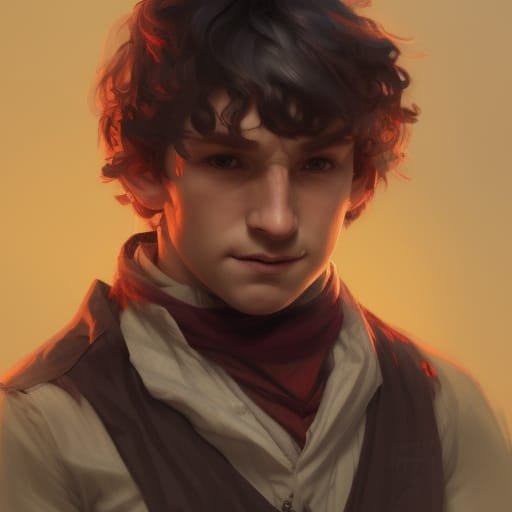
Artemis “Arty” Teafellow is a young Halfling Artificer who uses his tinkering skills to create and repair toys.
I picture him as having brass goggles atop a mess of walnut brown hair, a red scarf, a waistcoat, and a blue buccaneer jacket.
I originally wrote Artemis in the story Soso in March 2023. In that story, the great toymaker, Soso the Tortle, gave Arty a cache of complicated clockwork toys so he could keep them out of the hands of a mysterious organization called The League. Using Soso’s inventions, Arty explores and gets involved in things he really shouldn’t be getting into.
Arty is a young halfling with little life experience. He is fascinated by the magic of clockwork. I picture him as kind-hearted but naive, seeing the world as a kind of machine that operates off predictable rules. It doesn’t, of course, and he’s often flat-footed, making wrong assumptions.
His stories will involve steampunk and artificer (inventor) themes, dashed with maybe a little bit of Jules Verne, with a distant antagonist, The League, and what they represent.


Memories in Amber
Date: Friday, March 3, 2023
Competition: Australian Writer’s Center Furious Fiction
Max Words: 500
Criteria: Must include the concept of a CHAIR; the words ALBUM, BRIGHT, and CLICK; a character who has to make a CHOICE between two things.
The fire raged to cast a hazy, bright orange hue into the midnight sky above the river gorge. Nearby stands of pine trees were consumed by licking columns of flame, creating an inferno that filled the air with a thick layer of black smoke, causing Gisela's raw throat to burn.
“Stay here, Erika!” Gisela screamed, throwing herself out of the Jeep. On the passenger-side seat, Jinx, Erika’s Maine Coon, hissed from her cat carrier, while from behind, a neighbor’s car ladened with suitcases and garbage bags of worldly possessions raced by.
“Mom! You can’t go in there!” Erika cried, grasping at her from the back seat.
“I said, stay here!” Gisela growled, slamming the Jeep’s door to rush toward the garage. Gisela could see the skeletons of homes engulfed in a blazing holocaust only six lots down.
Bursting in, her kitchen was pitch black, and she stumbled to spill a stack of cleaned dishes, sending them crashing to the floor.
Rushing into her living room, Gisela frantically shoved rows of books from their shelving to grasp her grandmother’s album. It was a massive tome, bound in Moroccan leather and stitched with hemp cord, and weighed over fifty pounds. The woman had fled Konigsberg in January 1945, and its contents contained a century of family pictures and relics.
The heavy smoke suffocated and burned Gisela’s lungs. Gisela wheezed, struggling to breathe; she keeled in a deep cough, bracing her arm against the bookshelf. Recovering, she cradled the bulky album and lumbered to her bedroom. Throwing the album onto the bed, she rifled through her jewelry collection.
Glancing through the window, she saw the rooves of her neighbor’s on fire and the blustering, roiling wind kicking up a storm of debris and embers. Coughing, gasping for air, Gisela grunted and shoved her jewelry cabinet to the floor to tear open a dresser and rummage through its contents.
When her fingers felt the tiny shards, she grasped the necklace just a thunderous crash brought a flaming beam onto her bed. Fumes and hot ash burned Gisela’s eyes, and, shielding her head from the heat, she saw the ceiling was caving. Lunging for the book, she painfully recoiled; her fingertips burned as she reached for the album. Coughing into the crook of her elbow, Gisela turned and fled to exit her home through the front door.
Dashing to the Jeep, she swung the driver door open and dove inside.
“Here,” Gisela coughed, tossing the necklace at Erika.
“Mom?!” Erika asked, puzzled, examining the necklace. “Why?”
Clicking her seatbelt, she threw the vehicle into reverse and sped out of the driveway. Jostled, Jinx growled.
“She made it from amber found on the shores of the Baltic Sea after she left Konigsberg,” Gisela barked, throwing the Jeep into drive. Gritting her teeth, she spat, “She survived by fleeing the Russian army. I’ll be damned if it won’t survive this.”
And slamming her foot to the floor, the Jeep peeled away on the road.

Author’s Note: The Magnificent Maron Maloney

Over the last week, I wrote a 12k-word novelette responding to four Reedsy prompts, all about cats. I’d wanted to write a cross-posted story across their prompts for a while, and it seemed like a perfect opportunity to bring it up.
The story’s origins come from a 2017 D&D campaign where I created a showman villain that went about the countryside transforming children into animals. As the animals with the intellect of children were easier to control than regular animals, he could train them without a great deal of hassle. Eventually, the players would catch on to the ruse and need to fight Maron to free the children.
When I originally wrote him, I imagined him as something akin to the Child Catcher in Chitty Chitty Bang Bang. In this retelling, he’s an archetypal villain, even with the waxed handlebar mustache. He’d go around to various towns and small villages, lure children to his cart of splendors, and feed them a potion that’d turn them into an animal - the first animal that came to mind when they sipped the potion. That’s pretty much who he is here, too, except in this story, he indirectly captures children and directly transforms an adult drunkard.
I think of him as a failed alchemist and a mediocre wizard. The one thing he could make well was something like a permanent polymorph potion, and the spells he had were primarily defensive spells; Gaseous Form, Expeditious Retreat, and so on. The idea was to make him slippery and difficult to pin down during gameplay. When he escaped the party's clutches, he’d no sooner show up again in another town, and the party would have to try and capture him again. There were at least three separate incidents where the party ran into him before actually killing him.
In this story, Maron’s motivations are unclear, but he’s foiled by Benzie Fernbottom, a character I introduced A Thyme of Trouble as a side-kick to Elina Hogsbreath. That tradition continues in this work where Benzie works for Elina at the Swindle & Swine and discovers something completely wrong with Maron’s animals. Benzie tries to tell people about it, notably Elina, but he’s dismissed, mostly because people are too busy and enamored with Maron. Luckily, Elina provides some kitchen magic to help reveal the truth, and combat scenes are led by Kindle Muckwalker.

This was Kindle’s first written fight scene. I imagine Kindle as a haggard, blunt halfling, a bit like Norman Reedus’ Daryl Dixon of The Walking Dead. Complementing him was a druid named Ginny Greenhill, a D&D character I made for a quick campaign at an RPG con in 2018. I saw Ginny and Kindle working together as a team, he being the muscle and she providing support. I think it played well given the word constraints, but I would like to draw out the conflict to add more richness in later editions of the story.
At the end of the story, I have Maron’s psyche consumed by a flumph, for I saw the flumph as really humoring Maron and taking advantage of his wagon to see the world outside of the Underdark. I really like the idea of a spooky visage of Maron Maloney with this tentacled creature with eye stalks sitting atop his head, wandering the dark forest, essentially sightseeing on top of a mental zombie.
The flumph is an imaginative creature and nearly a joke in D&D as a whole. I saw the flumph as an opportunity to suggest that it was Maron’s first attraction, his only real animal, and when it didn’t draw the crowds, he added children transformed into animals. The flumph uses Maron as much as Maron uses it so that it can feed on emotion and explore the world. But it’s also a wonderous possibility, a weird unbelievable thing that we want to touch, and it kind of speaks to the premise of the story. In the end, it wanders, traveling the world in wonder, seeing things for the first time. Do you remember what that was like?

A big part of this story is the power of imagination and how, as working adults, we’re often caught up in the moment and we aren’t open to possibilities. Benzie believes the animals are more than what they seem and senses a danger, yet his intuitive ideas are ignored, risking everything. Kids are like that. They see something at the moment and bring our attention to it, but we’re quick to dismiss them. If halflings are analogous to children, then Benzie is our 7-year-old, tugging at our pants, trying to get us to pay attention to what they’re experiencing.
At the end of the story, I make some big reveals about transformed people, and I specifically carved out Kimchi, an orange cat that was the favorite of Maron Maloney’s. First, I wanted to instill a wonder of who she was and where did she go. Second, I wanted to keep the character for myself; the idea of a sentient cat roaming around the Swindle & Swine causing grief for Elina was just too good to pass up.
The commercial re-write of the story will likely span 20k+ words and include more depth into the characters and the events. There was only so much I could put on the page with a 3,000-word limitation.
The story is a cautionary tale: we ignore our intuition and our imagination at our peril. If we stay too rooted in our working world and fail to listen to our hearts, then we’ll end up in a place we don’t want to be. I thoroughly enjoyed writing it an hope that I didn’t piss off the Reedsy judges for cross-posting as 12k-word story. :)
As always, thanks for reading, and thanks for sticking around.
R

Author’s Note: Return to Me
This week, I wrote a response to a Reedsy Weekly short story competition entitled Return to Me where the prompt read:
“Write a story within a story within a ...”
At first, and I’ll be honest, I wasn’t very enamored with the concept. I had no real experience writing Matryoshka-like, nested stories, and the prompt grained against my brand. I feel my style is more direct, opting toward linear narratives that can be easily consumed and digested. I hate twisting up a story like a pretzel because it meets an artistic aesthetic. Why make something more convoluted than it had to be?
Further, I didn’t feel I could write a compelling nested story in under 3,000 words. My usual model for a story this size would be three acts in 1,000-word blocks, but this story called for maybe twice the number of acts and quick transitions between scenes. I had to insert a device to transition the reader between scenes without disrupting the flow of the story.
On the one hand, I was turned off by the prompt, thinking it’d be too much work for the reward. Yet on another, it was a cool technical challenge from an accomplished short story author, Erik Harper Klass. Thinking on it, if I were taking a creative writing course, would I turn down the opportunity to try a new technique? Nah! I’d try to do the work. So I hopped to it.
Researching these types of stories, I decided on the wolfhound as a transitionary device for the reader. When the wolfhound appeared in the narrative, I signaled that we had moved on to another scene.
The beginning of the story is actually four segments in. We encounter my antagonist, Rof Mok, attending a funeral service for a fallen soldier, Wen Fak. Before that, we met Rof as a desperate thief, looting a grave near the Temple of Silvanus in Mumling. Rof Mok sins, stealing from the dead, and is rewarded by encountering the wolfhound.
The hound is a grim - an omen - that conveys a curse. Throughout the story, the grim haunts Rof Mok, driving him mad and to a point where suicide becomes his only option to escape it, taking us right back to the opening scene with Bartram.

Grims are old folklore. Grims are guardians and defend a church from those who’d commit sacrilege against it; they often take the form of black dogs. In the past, black dogs were even buried under the cornerstone of a church so that their spirit would guard the grounds. I took some license with the legend conveying a curse that followed Rof Mok around.
The nested story needed a more sympathetic/empathetic flavor to contrast against the cautionary, spooky folklore. I used the trope of a reflecting widow to weave the second story in. Reflecting on a story allowed me to stay in the past and build a foundation for Sae Fak’s backstory. I wanted to get the reader to like Wen Fak and feel sadness/empathy for Sae so that returning the ring to Wen meant something to the reader.
So what I wanted from the story was a little sweet and sour: a love story nested within a darker, more ominous one. When I read this story aloud to my beta team, I found that everyone would get really tuned in during the love story and brace for the ending. The circular movements of the story with its transitions also forced me to pause a little while reading it, and I felt it took longer to read. A more winding trail, I think, rather than a direct route, and the mind seemed to play with it well.
Thinking about transitions in that way was, in itself, a good experience and another tool in my writer’s kit. I really liked how the story turned out. I’ll definitely use it again. Bartram Humblefoot played a good protagonist to my villain and fit right in with Wen Fak’s story.
In this story, I mention that Bartram’s 66 years old, and I foresee this story taking place a few years earlier than The Murkwode Reaving.
Some “Behind Baseball” Details:
Wen Fak is actually the name of a Mumling NPC Fighter used in my D&D campaign. The original Wen Fak was an 80-year-old veteran that kept rolling nat-20’s and saving the party’s bacon. He was truly an awesome NPC. Wen Fak eventually died, eaten by a giant frog; I didn’t want to have to explain giant frogs in this story, and comedy wasn’t what I was going for, so I went with goblins. After I wrote the story, I shared it with all my players. They loved it and thought it was a fitting tribute.
I was going to write a grim into The Grotesque of Silvanus when I prepared its commercial version. That story also takes place at the same temple. I probably still will.
Mumling is mentioned in several of my works but most notably in The Murkwode Reaving. Bartram is a military commander for a Gaelwyn (human) city-state - Mumling - and the contention between his role as an officer and his religious calling is explored in that work.
In the story, I mention Brigantia, and in The Blood of the Catacomb Captive, I explored Brigantia’s wealth inequality due to its silver mines.
As always, thanks for reading, and thanks for sticking around.
R

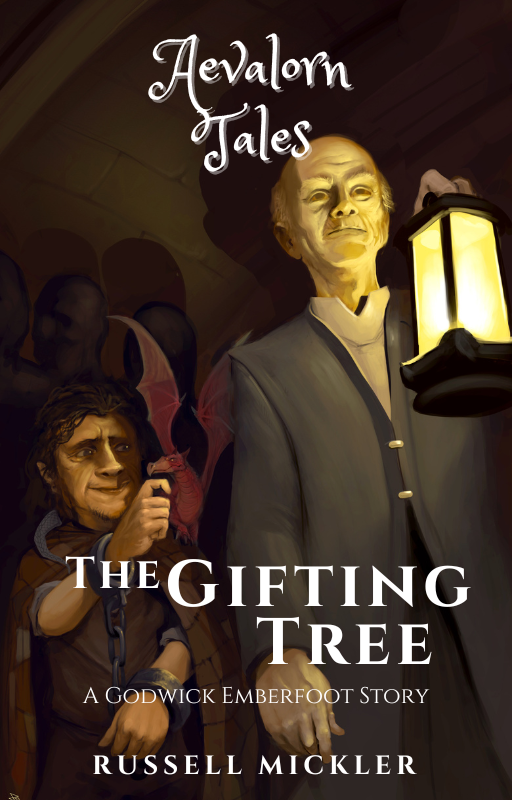
Who is Godwick Emberfoot

Godwick Emberfoot is a Halfling Warlock enslaved to the Archfae Aurusel, the Great Gardener.
There’s a lot to parse in that sentence. A warlock is a person who has made a pact with an otherworldly being. The magic he wields is gifted by their power. His pact is one of the chain: he’s subservient to his patron and soul-slaved. When I describe Godwick, he’s shackled at his wrists with a chain that runs between them.
His patron is the Archfae Aurusel. An Archfae is a powerful creature with the influence, understanding, and power to bend the Faewild to its will. The Faewild is a parallel plane where the fae live, typified by magic, chaos, and change. Aurusel maintains a garden in the Faewild and is a powerful creature in his own right.
Godwick is in possession of a magic item that I call a patchwork cloak. It’s nothing special - I imagine it as a dingy patchwork quilt made into a cloak with a hood. Its special power, though, allows Godwick to plane shift, to move between different planes of existence at will.
I see Godwick as a haggard soul teetering on the edge of sanity. He somehow came in possession of the patchwork cloak and wandered into Aurusel’s garden in the Faewild. He wasn’t outright destroyed, but rather enslaved, for Aurusel has work for a plane-shifting halfling. Being enslaved by a powerful otherworldly force and bouncing around between planes of existence rattles the mind, and his is stretched too thin.
Godwick’s face is marred with deep wrinkles and crevices, sullen eyes, and weathered skin. Inky-black, greasy hair, that runs to his back. His use of pact magic wears on his body. I perceive some of his halflingness as eroded in some way.

A part of Godwick’s pact magic allows him to find a familiar, a magicked spiritual companion. Godwick’s familiar is the pseudodragon Greymalken. Greymalken is a twist on Shakespeare’s Graymalkin, an old female cat, a witch’s familiar, mentioned in the opening of Macbeth.
The first story I wrote for Godwick was his connecting origin story to Greymalken entitled Bargains with Dragons.
Godwick is my answer to several characters that I’ve enjoyed in fantasy and science fiction. He wears a multicolored patchwork cloak. This is a reference to Joseph and the Amazing Technicolor Dreamcoat and a comic book character named Shade the Changing Man. He’s also, absolutely, a John Constantine type of character.
His stories will be fantastical, traveling to strange places, and meeting otherworldly creatures in the Faewild.



What is the Difference Between the Commercial and Non-Commercial Versions of my Work?
I wanted to take a moment to explain the difference between my commercial work and my non-commercial work.
I use Inkitt, Reedsy, and other sites as a staging area for my draft work and serialized fiction. When I post something there, it’s usually a draft and isn’t entirely cleaned up. I put it on these sites to gain visibility and get feedback from my beta readers.
I’ll revise the work until I feel like it’s reasonably presentable and then close the project out on the non-commercial site. And I leave it there so I can attract new readers who might be interested in my work.
Meanwhile, if I decide to take a project through a commercial channel (Apple Books, Amazon Books, and Google Books), I’ll walk through another round of editing to clean it up and make it suitable for people paying for something.
I’ll also usually change or extend the work to differentiate it from the non-commercial. I’ll often revise the work for clarity, add more content to the story, and change the ending somehow.
The idea is to, chiefly, spread the good word about halflings and Aevalorn Tales. I’d love to have everyone in the world reading my fun stories about halflings.
And so for those with the means and who would like to support me, I offer my commercial work.
A couple of thoughts here:
I’ll never be Stephen King. I can’t write a single title and have millions of people buy it. So I can’t write a single book and call it good. I have to write a lot to even be seen.
I’ll never retire from my writing. I do this for fun. If people pick up my commercial work, it’s like pennies were thrown into my busking hat.
I want everyone to read my stuff. Really, it’s true, and I don’t want money to be an obstacle. I mean, here, have a book. That’s what I’m all about.
Plus, I always offer my commercial work through raw files available for cheap-cheap-cheap on the website.
Anyway, there we go, and thanks for reading!
R

Author’s Notes: The Garden of Reflection
I wrote this story in response to a Reedsy prompt concerning a character that wants to disappear and does.
I wanted to draw from the idea when a person contracts a chronic disease or a terminal illness, how they might feel like a burden or inconvenience to others - how they might want to disappear.
My first thought was to make a ghost story with my bard character, Joliver Barleywood. As I started outlining, I didn’t want to trivialize the subject and felt I needed to go deeper. Jayleigh Warmhollow was a better fit; she’s my character for more complex and emotional themes.
I thought the gorgon slant was a perfect fit. It’s difficult to imagine a life where you couldn’t interact with people you love without the risk of “infecting” them.
The entry into the story takes the reader into an aftermath. The villagers tried to burn their town to destroy Uriah. The mood is deliberately bleak and sullen, and when we meet Jayleigh, she’s prepared for combat, to do whatever is necessary to restore a balance to nature.
Mythology isn’t kind to gorgons. We usually encounter them when they’re grown up, resentful, angry, and evil. They’re usually a protagonist who ends up losing their snake-ridden head. The reader’s rooting for it, of course, because we don’t want to see our brave protagonist turned to stone. That’s not how I wanted this story to end.
In this story, I wanted my reader to see Uriah as innocent: she was the victim of an unfortunate circumstance, a disease. She didn’t deserve to get her head stuffed in a bag. Instead, how can we treat someone like this with dignity?
Jayleigh wants to bargain with the gorgon and find an alternative to killing her. Like anyone who survives a chronic illness would tell you, living is harder than dying, so maybe, for some, death is a preferred option. Most in our society don’t have the option to die gracefully and on their own terms; ten states plus the DOC have “right-to-die” laws. In forty other states, the ideal value of life trumps the prolonged suffering of an individual, especially when it’d be more merciful to simply end it. When I have Jayleigh spin around and confront the townsfolk in this story, I’m really yelling at “people” who don’t have any say in Uriah’s suffering.
In the story, death always remained an option in the form of Jayleigh’s sickle. Scythes and sickles have a direct association with death, but it’s also a reference to a D&D constraint where druids can use limited forms of bladed weapons. A sickle is one.
That said, I wanted Uriah to have more options than death. Isolation is a common theme with gorgons given their curse, but I think it’s also something that the chronically ill experience. Some people withdraw from their social connections either through choice or circumstance. I felt that experience would imbitter Uriah and make her resentful; a life of loneliness was no life at all. I made a reference to Uriah as being a “baby gorgon”, like, she’s “young” and not set in her ways. Her mind hasn’t “eroded” into madness and she was still pliable. I think this is also true for people suffering from illness. Instilling hope is important to a treatment plan. Hope, in this case, was a life shared with other people, a community, that could accept her for what she was.
The Galeb Duhr is a race in D&D with a long history in the game. They’re neutral creatures and 5e even points out that they’re disposed to working with druids. Given their immunity to petrification and thousands of years of lifespan, I felt they’d make a suitable “family of choice” for a gorgon if she chose it. They offered a way out that we don’t see in mythology.
With Jayleigh’s mask, I deviated from D&D’s rules but I imagined it as something like a True Seeing spell woven into an ordinary mask. It was a convenient tool for both Jayleigh and Uriah.
I think the underpinning message is that all chronically ill have their own agency. As powerless as they might feel, they get to choose for themselves what they want out of the life they’re handed.