Blog

Author’s Note: The Magnificent Maron Maloney

Over the last week, I wrote a 12k-word novelette responding to four Reedsy prompts, all about cats. I’d wanted to write a cross-posted story across their prompts for a while, and it seemed like a perfect opportunity to bring it up.
The story’s origins come from a 2017 D&D campaign where I created a showman villain that went about the countryside transforming children into animals. As the animals with the intellect of children were easier to control than regular animals, he could train them without a great deal of hassle. Eventually, the players would catch on to the ruse and need to fight Maron to free the children.
When I originally wrote him, I imagined him as something akin to the Child Catcher in Chitty Chitty Bang Bang. In this retelling, he’s an archetypal villain, even with the waxed handlebar mustache. He’d go around to various towns and small villages, lure children to his cart of splendors, and feed them a potion that’d turn them into an animal - the first animal that came to mind when they sipped the potion. That’s pretty much who he is here, too, except in this story, he indirectly captures children and directly transforms an adult drunkard.
I think of him as a failed alchemist and a mediocre wizard. The one thing he could make well was something like a permanent polymorph potion, and the spells he had were primarily defensive spells; Gaseous Form, Expeditious Retreat, and so on. The idea was to make him slippery and difficult to pin down during gameplay. When he escaped the party's clutches, he’d no sooner show up again in another town, and the party would have to try and capture him again. There were at least three separate incidents where the party ran into him before actually killing him.
In this story, Maron’s motivations are unclear, but he’s foiled by Benzie Fernbottom, a character I introduced A Thyme of Trouble as a side-kick to Elina Hogsbreath. That tradition continues in this work where Benzie works for Elina at the Swindle & Swine and discovers something completely wrong with Maron’s animals. Benzie tries to tell people about it, notably Elina, but he’s dismissed, mostly because people are too busy and enamored with Maron. Luckily, Elina provides some kitchen magic to help reveal the truth, and combat scenes are led by Kindle Muckwalker.

This was Kindle’s first written fight scene. I imagine Kindle as a haggard, blunt halfling, a bit like Norman Reedus’ Daryl Dixon of The Walking Dead. Complementing him was a druid named Ginny Greenhill, a D&D character I made for a quick campaign at an RPG con in 2018. I saw Ginny and Kindle working together as a team, he being the muscle and she providing support. I think it played well given the word constraints, but I would like to draw out the conflict to add more richness in later editions of the story.
At the end of the story, I have Maron’s psyche consumed by a flumph, for I saw the flumph as really humoring Maron and taking advantage of his wagon to see the world outside of the Underdark. I really like the idea of a spooky visage of Maron Maloney with this tentacled creature with eye stalks sitting atop his head, wandering the dark forest, essentially sightseeing on top of a mental zombie.
The flumph is an imaginative creature and nearly a joke in D&D as a whole. I saw the flumph as an opportunity to suggest that it was Maron’s first attraction, his only real animal, and when it didn’t draw the crowds, he added children transformed into animals. The flumph uses Maron as much as Maron uses it so that it can feed on emotion and explore the world. But it’s also a wonderous possibility, a weird unbelievable thing that we want to touch, and it kind of speaks to the premise of the story. In the end, it wanders, traveling the world in wonder, seeing things for the first time. Do you remember what that was like?

A big part of this story is the power of imagination and how, as working adults, we’re often caught up in the moment and we aren’t open to possibilities. Benzie believes the animals are more than what they seem and senses a danger, yet his intuitive ideas are ignored, risking everything. Kids are like that. They see something at the moment and bring our attention to it, but we’re quick to dismiss them. If halflings are analogous to children, then Benzie is our 7-year-old, tugging at our pants, trying to get us to pay attention to what they’re experiencing.
At the end of the story, I make some big reveals about transformed people, and I specifically carved out Kimchi, an orange cat that was the favorite of Maron Maloney’s. First, I wanted to instill a wonder of who she was and where did she go. Second, I wanted to keep the character for myself; the idea of a sentient cat roaming around the Swindle & Swine causing grief for Elina was just too good to pass up.
The commercial re-write of the story will likely span 20k+ words and include more depth into the characters and the events. There was only so much I could put on the page with a 3,000-word limitation.
The story is a cautionary tale: we ignore our intuition and our imagination at our peril. If we stay too rooted in our working world and fail to listen to our hearts, then we’ll end up in a place we don’t want to be. I thoroughly enjoyed writing it an hope that I didn’t piss off the Reedsy judges for cross-posting as 12k-word story. :)
As always, thanks for reading, and thanks for sticking around.
R

Author’s Note: Return to Me
This week, I wrote a response to a Reedsy Weekly short story competition entitled Return to Me where the prompt read:
“Write a story within a story within a ...”
At first, and I’ll be honest, I wasn’t very enamored with the concept. I had no real experience writing Matryoshka-like, nested stories, and the prompt grained against my brand. I feel my style is more direct, opting toward linear narratives that can be easily consumed and digested. I hate twisting up a story like a pretzel because it meets an artistic aesthetic. Why make something more convoluted than it had to be?
Further, I didn’t feel I could write a compelling nested story in under 3,000 words. My usual model for a story this size would be three acts in 1,000-word blocks, but this story called for maybe twice the number of acts and quick transitions between scenes. I had to insert a device to transition the reader between scenes without disrupting the flow of the story.
On the one hand, I was turned off by the prompt, thinking it’d be too much work for the reward. Yet on another, it was a cool technical challenge from an accomplished short story author, Erik Harper Klass. Thinking on it, if I were taking a creative writing course, would I turn down the opportunity to try a new technique? Nah! I’d try to do the work. So I hopped to it.
Researching these types of stories, I decided on the wolfhound as a transitionary device for the reader. When the wolfhound appeared in the narrative, I signaled that we had moved on to another scene.
The beginning of the story is actually four segments in. We encounter my antagonist, Rof Mok, attending a funeral service for a fallen soldier, Wen Fak. Before that, we met Rof as a desperate thief, looting a grave near the Temple of Silvanus in Mumling. Rof Mok sins, stealing from the dead, and is rewarded by encountering the wolfhound.
The hound is a grim - an omen - that conveys a curse. Throughout the story, the grim haunts Rof Mok, driving him mad and to a point where suicide becomes his only option to escape it, taking us right back to the opening scene with Bartram.

Grims are old folklore. Grims are guardians and defend a church from those who’d commit sacrilege against it; they often take the form of black dogs. In the past, black dogs were even buried under the cornerstone of a church so that their spirit would guard the grounds. I took some license with the legend conveying a curse that followed Rof Mok around.
The nested story needed a more sympathetic/empathetic flavor to contrast against the cautionary, spooky folklore. I used the trope of a reflecting widow to weave the second story in. Reflecting on a story allowed me to stay in the past and build a foundation for Sae Fak’s backstory. I wanted to get the reader to like Wen Fak and feel sadness/empathy for Sae so that returning the ring to Wen meant something to the reader.
So what I wanted from the story was a little sweet and sour: a love story nested within a darker, more ominous one. When I read this story aloud to my beta team, I found that everyone would get really tuned in during the love story and brace for the ending. The circular movements of the story with its transitions also forced me to pause a little while reading it, and I felt it took longer to read. A more winding trail, I think, rather than a direct route, and the mind seemed to play with it well.
Thinking about transitions in that way was, in itself, a good experience and another tool in my writer’s kit. I really liked how the story turned out. I’ll definitely use it again. Bartram Humblefoot played a good protagonist to my villain and fit right in with Wen Fak’s story.
In this story, I mention that Bartram’s 66 years old, and I foresee this story taking place a few years earlier than The Murkwode Reaving.
Some “Behind Baseball” Details:
Wen Fak is actually the name of a Mumling NPC Fighter used in my D&D campaign. The original Wen Fak was an 80-year-old veteran that kept rolling nat-20’s and saving the party’s bacon. He was truly an awesome NPC. Wen Fak eventually died, eaten by a giant frog; I didn’t want to have to explain giant frogs in this story, and comedy wasn’t what I was going for, so I went with goblins. After I wrote the story, I shared it with all my players. They loved it and thought it was a fitting tribute.
I was going to write a grim into The Grotesque of Silvanus when I prepared its commercial version. That story also takes place at the same temple. I probably still will.
Mumling is mentioned in several of my works but most notably in The Murkwode Reaving. Bartram is a military commander for a Gaelwyn (human) city-state - Mumling - and the contention between his role as an officer and his religious calling is explored in that work.
In the story, I mention Brigantia, and in The Blood of the Catacomb Captive, I explored Brigantia’s wealth inequality due to its silver mines.
As always, thanks for reading, and thanks for sticking around.
R

Who is Godwick Emberfoot

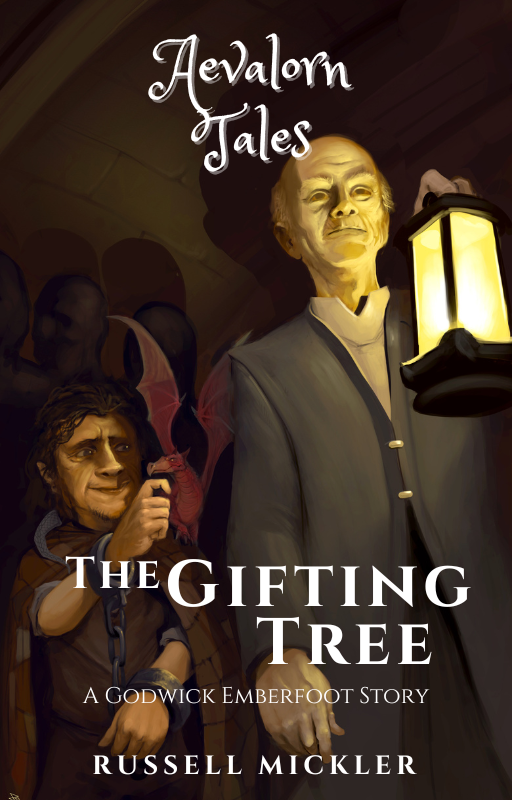
Godwick Emberfoot is a Halfling Warlock enslaved to the Archfae Aurusel, the Great Gardener.
There’s a lot to parse in that sentence. A warlock is a person who has made a pact with an otherworldly being. The magic he wields is gifted by their power. His pact is one of the chain: he’s subservient to his patron and soul-slaved. When I describe Godwick, he’s shackled at his wrists with a chain that runs between them.
His patron is the Archfae Aurusel. An Archfae is a powerful creature with the influence, understanding, and power to bend the Faewild to its will. The Faewild is a parallel plane where the fae live, typified by magic, chaos, and change. Aurusel maintains a garden in the Faewild and is a powerful creature in his own right.
Godwick is in possession of a magic item that I call a patchwork cloak. It’s nothing special - I imagine it as a dingy patchwork quilt made into a cloak with a hood. Its special power, though, allows Godwick to plane shift, to move between different planes of existence at will.
I see Godwick as a haggard soul teetering on the edge of sanity. He somehow came in possession of the patchwork cloak and wandered into Aurusel’s garden in the Faewild. He wasn’t outright destroyed, but rather enslaved, for Aurusel has work for a plane-shifting halfling. Being enslaved by a powerful otherworldly force and bouncing around between planes of existence rattles the mind, and his is stretched too thin.
Godwick’s face is marred with deep wrinkles and crevices, sullen eyes, and weathered skin. Inky-black, greasy hair, that runs to his back. His use of pact magic wears on his body. I perceive some of his halflingness as eroded in some way.

A part of Godwick’s pact magic allows him to find a familiar, a magicked spiritual companion. Godwick’s familiar is the pseudodragon Greymalken. Greymalken is a twist on Shakespeare’s Graymalkin, an old female cat, a witch’s familiar, mentioned in the opening of Macbeth.
The first story I wrote for Godwick was his connecting origin story to Greymalken entitled Bargains with Dragons.
Godwick is my answer to several characters that I’ve enjoyed in fantasy and science fiction. He wears a multicolored patchwork cloak. This is a reference to Joseph and the Amazing Technicolor Dreamcoat and a comic book character named Shade the Changing Man. He’s also, absolutely, a John Constantine type of character.
His stories will be fantastical, traveling to strange places, and meeting otherworldly creatures in the Faewild.



What is the Difference Between the Commercial and Non-Commercial Versions of my Work?
I wanted to take a moment to explain the difference between my commercial work and my non-commercial work.
I use Inkitt, Reedsy, and other sites as a staging area for my draft work and serialized fiction. When I post something there, it’s usually a draft and isn’t entirely cleaned up. I put it on these sites to gain visibility and get feedback from my beta readers.
I’ll revise the work until I feel like it’s reasonably presentable and then close the project out on the non-commercial site. And I leave it there so I can attract new readers who might be interested in my work.
Meanwhile, if I decide to take a project through a commercial channel (Apple Books, Amazon Books, and Google Books), I’ll walk through another round of editing to clean it up and make it suitable for people paying for something.
I’ll also usually change or extend the work to differentiate it from the non-commercial. I’ll often revise the work for clarity, add more content to the story, and change the ending somehow.
The idea is to, chiefly, spread the good word about halflings and Aevalorn Tales. I’d love to have everyone in the world reading my fun stories about halflings.
And so for those with the means and who would like to support me, I offer my commercial work.
A couple of thoughts here:
I’ll never be Stephen King. I can’t write a single title and have millions of people buy it. So I can’t write a single book and call it good. I have to write a lot to even be seen.
I’ll never retire from my writing. I do this for fun. If people pick up my commercial work, it’s like pennies were thrown into my busking hat.
I want everyone to read my stuff. Really, it’s true, and I don’t want money to be an obstacle. I mean, here, have a book. That’s what I’m all about.
Plus, I always offer my commercial work through raw files available for cheap-cheap-cheap on the website.
Anyway, there we go, and thanks for reading!
R

Author’s Notes: The Garden of Reflection
I wrote this story in response to a Reedsy prompt concerning a character that wants to disappear and does.
I wanted to draw from the idea when a person contracts a chronic disease or a terminal illness, how they might feel like a burden or inconvenience to others - how they might want to disappear.
My first thought was to make a ghost story with my bard character, Joliver Barleywood. As I started outlining, I didn’t want to trivialize the subject and felt I needed to go deeper. Jayleigh Warmhollow was a better fit; she’s my character for more complex and emotional themes.
I thought the gorgon slant was a perfect fit. It’s difficult to imagine a life where you couldn’t interact with people you love without the risk of “infecting” them.
The entry into the story takes the reader into an aftermath. The villagers tried to burn their town to destroy Uriah. The mood is deliberately bleak and sullen, and when we meet Jayleigh, she’s prepared for combat, to do whatever is necessary to restore a balance to nature.
Mythology isn’t kind to gorgons. We usually encounter them when they’re grown up, resentful, angry, and evil. They’re usually a protagonist who ends up losing their snake-ridden head. The reader’s rooting for it, of course, because we don’t want to see our brave protagonist turned to stone. That’s not how I wanted this story to end.
In this story, I wanted my reader to see Uriah as innocent: she was the victim of an unfortunate circumstance, a disease. She didn’t deserve to get her head stuffed in a bag. Instead, how can we treat someone like this with dignity?
Jayleigh wants to bargain with the gorgon and find an alternative to killing her. Like anyone who survives a chronic illness would tell you, living is harder than dying, so maybe, for some, death is a preferred option. Most in our society don’t have the option to die gracefully and on their own terms; ten states plus the DOC have “right-to-die” laws. In forty other states, the ideal value of life trumps the prolonged suffering of an individual, especially when it’d be more merciful to simply end it. When I have Jayleigh spin around and confront the townsfolk in this story, I’m really yelling at “people” who don’t have any say in Uriah’s suffering.
In the story, death always remained an option in the form of Jayleigh’s sickle. Scythes and sickles have a direct association with death, but it’s also a reference to a D&D constraint where druids can use limited forms of bladed weapons. A sickle is one.
That said, I wanted Uriah to have more options than death. Isolation is a common theme with gorgons given their curse, but I think it’s also something that the chronically ill experience. Some people withdraw from their social connections either through choice or circumstance. I felt that experience would imbitter Uriah and make her resentful; a life of loneliness was no life at all. I made a reference to Uriah as being a “baby gorgon”, like, she’s “young” and not set in her ways. Her mind hasn’t “eroded” into madness and she was still pliable. I think this is also true for people suffering from illness. Instilling hope is important to a treatment plan. Hope, in this case, was a life shared with other people, a community, that could accept her for what she was.
The Galeb Duhr is a race in D&D with a long history in the game. They’re neutral creatures and 5e even points out that they’re disposed to working with druids. Given their immunity to petrification and thousands of years of lifespan, I felt they’d make a suitable “family of choice” for a gorgon if she chose it. They offered a way out that we don’t see in mythology.
With Jayleigh’s mask, I deviated from D&D’s rules but I imagined it as something like a True Seeing spell woven into an ordinary mask. It was a convenient tool for both Jayleigh and Uriah.
I think the underpinning message is that all chronically ill have their own agency. As powerless as they might feel, they get to choose for themselves what they want out of the life they’re handed.
Author’s Notes: The Keening Cup
On Tuesday, January 3, 2023, I published The Keening Cup to Wattpad.

I wrote this story in response to a Reedsy Writing Prompt:
“Your character always makes the same promise: to change. Will they finally make it happen this time?”
This story takes place in Pondaroak in the Aevalorn Parishes, with Elina Hogsbreath at the Swindle & Swine.
Keening is the act of wailing in grief over a dead person. Wailing women figure prominently in Celtic mythology and certainly have a place in the Swindle.
I borrowed the concept of a banshee - a spirit that heralds the death of a family member - and tied it to a blackthorn wood cup.
Blackthorn trees are common throughout the British Isles and are viewed in Wicca tradition as being a trickster shrub; some Celtic lore assigns negative, sinister properties to the tree. This is the second time I wrote in a blackthorn to symbolize a sinister space or item; the first time was in The Murkwode Reaving.
I introduced a vain, attention-grubbing halfling, Horwich Cobbleberry, who uses a cursed cup to garner attention from fellow townsfolk. Horwich (Horry, he’s an attention whore, get it?), promises Elina every year that he’ll stop using the cup, and it’s a promise that he makes every year.
Horwich isn’t too difficult to imagine as an individual. People who brashly tempt fate, thinking they’ll never be harmed? Or without the foresight to see how others might be harmed by their own actions? Horwich isn’t too complicated and is probably someone we’d find in a bar on New Year’s Eve.
A part of the story is the idea of New Year celebrations. What if you could know if you were to die in the next year? Would you want to know? Would you dare to know? That’s kind of the crux of the story, where Horry is playing a double-dog dare every year.
The story’s theme is about irrational brashness that can lead to despair. Why do we tempt fate? Why do we risk knowing something we’d be better off not knowing? What’s the allure of celebrating people who are reckless with our own safety? Like, stepping into a car knowing the guy driving is intoxicated. Why do we encourage it, and why are we so accepting of their risk?
I start the story at the ending, where Elina’s digging a hole to bury the cursed cup. I thought that would make a good wrap on the story after I sent Horwich bounding into the forest.
When Elina enters her kitchen, she reviews a list of hallucinogenic herbs and psychoactive plants (belladonna, mandrake, sumac, poke root), and the astute reader gets the impression that she’s preparing reagents to create a hallucinatory effect. One of my advance readers actually burst out loud laughing after reading what I was up to in the story.
So Elina appears to be sabotaging Cobbleberry’s big moment, but she’s not sociopathic. Hopefully, I project to the reader that she’s just kind of done with the promises and wants to end the cup’s influence in her inn, once and for all. She doesn’t want to hurt Horwich, but he’s got to be taught a lesson so the yearly ritual can be brought to an end.
In my attempt to show Elina really cares about him, she reminds Horwich where to find a bullaun and to help himself. In another Celtic tradition, a bullaun is a cure or curse stone where its waters are magical.
So, is the Keening Cup really enchanted? What the banshee real or just a hallucination? I think that’s part of the story's charm where I really don’t need to say - the reader can make up their own mind.
I’ll tell you the idea of a cursed cup buried out back the Swindle & Swine is very appealing. I wonder what else is buried out there? Sounds like the stuff of a new story.
As always, thanks for reading, and thanks for sticking around. :)
R

5 Things I Avoid as a Fantasy Author
I have opinions.
This is one of my “get off my lawn” rants, so it carries a tone. I’ll apologize in advance.
Readers who follow my writing might notice that I tend to avoid certain tropes.
I avoid them because I find their presence in the fantasy genre as boneheaded, redundant, and dull.
Here at the five things that I try to avoid in my stories.
DRAGONS
Dragon tears, dragon blood, dragon venom, dragon people, dragon genes, dragon teeth, dragon gems, dragon wings, eyes of a dragon, dragon riders, blah blah blah.
If you think about it, a dragon is an apex being with no rival. Aside from others of its kind, just a clutch of dragons would decimate an ecosystem. The brood would have to spread out to find enough food to eat or gold to horde, so really, dragons shouldn’t be depicted as coexisting with nature but ravaging it. They’re an enemy of nature. If we’re to find a dragon, we should expect to find a barren countryside with all of its natural resources expended. After they’d consume everything, then they just fly right off and move to another until the fantasy world the author so diligently built is just mud and slag.
So unless the author places the dragon into a bleak wasteland where it’s consumed everything, why read the book? And even then, what’s there to write about because their species is dying. Perhaps if we zoomed-in on the moment when the last dragon inhaled its last breath so that nature could recover from the massive devastation it caused. Now there’s a good story!
The moment I start reading a fantasy book with a dragon in it, I get skeptical. I’m really tired of giant, anatomically-impossible, flying lizards with magical powers. Aren’t you?
ELVES
Groan. I’m so sick of elves.
They’re like Superman in the DC Universe.
Is there nothing that can stop them short of this super rare mineral that’s remarkably abundant on Earth?
In every respect, elves are so far superior to mankind that they should be a dominant species and enslave man (a la, “The Fey”, Kristine Rusch).
What’s this “friendship” between an evolutionary superior species and a bunch of lesser wanna-be’s? Did we see Homo Sapien and the Neandertal “get along”, go on quests together, have a pint of ale at the nearby tavern? No! Homo Sapiens came in with their larger brain and beat the smaller brains out of the neandertal if they didn’t outright fornicate with them to make them part of the “family”.
Elves are ridiculously overpowered critters. They’re so overpowered that, in the context of writing about them, their culture, art, scholarship, and instruments of war have no comparison. There are no threats, so, like Superman, you have to throw gods at them to create a conflict.
When you write about elves, you might as well be writing about demigods. In fact, in my writing, I do regard elves as demigods, and I don’t necessarily incorporate them into principal characters. The moment I introduce an elf protagonist, they’d steal the show; they have no flaws. They don’t even die appropriately. They, like, board a boat to go the east rather than just simply dying and decaying, like the rest of us.
Ugh! Elves! Really?
ROMANCE
I am so sick and tired of seeing “best selling” books capitalize on hyper-sexualized supernatural (read: werewolf or vampire) BDSM dominatrixes.
Further, why does the female protagonist, to be interesting, need to be something fantastic? Like, chosen to breed? A mistress? Part alien? Or own a “reverse harem”?
Can’t we conceive of a female protagonist with no special powers who doesn’t have an “off-the-rails” libido? Or desperate to find their one true love at the expense of living their own damned life? Who is simply a woman and a person all at the same time?
I’m also very sick of romance, as a genre, spilling into fantasy and eroding the search algorithms. If you’re going to write a romance, put it on a cruise ship with a bald captain and be done with it. Every romance everywhere should simply be on the Love Boat. Get out of my magical forests with bugbears, halflings, and unicorns; they don’t get a flip about your emotional needs.
I don’t write romance - I write fantasy! I want to escape reality, not lament about how bad my own love life is, and pine over the unobtainable.
USELESS DESCRIPTIONS
One of the biggest annoyances that I have about modern fiction is the outright need to explain things in seven pages that would take one paragraph.
I’m lookin’ at you Robert Jordan and George R. R. Martin!
When you write about a meadow, you should say, “The protagonist entered a meadow,” not provide seven pages of description about the meadow since it has no bearing on the outcome of the story! It’s just filler! It’s like, how many ways can you say that the character entered a meadow? Just one! “The character entered a meadow!”
Same for food. Hey, I like to spend a few paragraphs explaining food in my work, true, but do we need a history of each meal to be offered as some rationale by the author as to why it’s being served? Do I need to know where the potatoes came from, who they were cultivated by, and how they were yanked out of the ground? No! “Baked potatoes were on the table, and they were hot.” That’s all you need to say!
What’s funny about this is that I’ve always joked that my own novels would actually be about 10 pages long. The protagonist thinks this, does that, stabs this person, celebrates, end of story. I guess this is why I write short stories. Why take seven pages to describe something? I don’t get it. And it’s boring. Stop it!
MONARCHIES
Kingdoms… cringe. I’m so sick of kings. And their doms.
Why must a monarchy govern everything? Why is there a singular guy (usually white) in charge all things? And everybody answers to him?
I mean, why not have a perfectly acceptable fantasy setting that’s ruled by a council of old women? Or how about if people shake potato bugs in a jar to make decisions? Or, looking at indigenous cultures, are there committees or groups or people who make complex decisions over lifetimes? Certainly, in a fantasy setting, we can do better than monarchies.
I really like the potato bugs in a jar governance style. I think I’ll try using that.
Anyway, there’s my rant. Thanks for reading!
R

Author’s Note: The Murkwode Reaving
On Thursday November 24, 2022, I published The Murkwode Reaving on Wattpad.

So the title is fantastical and archaic.
The Murkwode comes from the Scottish word murk combined with the old English word for wood, wode.
Tolkien already did the Mirkwood, so I couldn’t do that, and the video game, The Elder Scrolls, did Murkwood. Still, I wanted my own “murky woods.”
Reaving is a very old word that most would recognize from the Scottish word “reive”; present participle of “reave”, which is also Old English: to rob, raid, steal, plunder.
I try to pair these concepts explored in the narrative, like trespass, to try to build the larger idea: this is a story where my heroes work their way through an old wood to plunder a grave.
My goals for this project were to:
Write a 12,000-word gritty action and adventure story involving a soldier with PTSD.
Feature Bartram Humblefoot.
Relate Bartram’s Paladin ordination.
The antagonist would be Confessor Bog.
The moral would be that you can’t take anything for granted; anything important needs to be earned.
The final draft of the work landed around 16,500 words. So that worked out.
Readers of my work would recognize Confessor Bog as the antagonist in The Ballad of Skyer Dannon, but the Ballad took place 400 years before the events in this story, and Confessor Bog was burned alive. How’d there be anything left? And that’s where the wraith and wight elements of the story came from. I needed a way to explain Bog's presence, which fit nicely. Readers would also recognize the way Bog died and his vestments; I liked the cross-over.
When I started, I knew I would kill off one of the three soldiers accompanying Bartram. I first thought it’d be Rab. But after working with the second episode, I thought I could do more with Rab while he was alive and have it contribute to the moral. I made up Platt’s backstory on the fly and found that it could also work with the project's overall theme.
I try to bring faith into Bartram’s stories; this story was no exception. That and a little bit of magic addressed the PTSD issues and spoke to the larger moral.
This work probably isn’t for everybody. It contains some challenging themes surrounding PTSD, adult language, graphic gore, and medieval violence.
I think the reception’s been good; rankings after three weeks:

There are a lot of D&D elements in the work that would attract the gamer to the story.
They’d notice the Paladin’s capabilities, the Oath of the Ancients and its abilities, the monster’s capabilities, some of the spells, and the constraints explored in the combat sequences.
I think non-gamers would appreciate the story for its action and grit, and its attempt to make something bigger out of the story.
This story is about the importance of earning something.
You just can’t be a great fighter overnight, like in Rab’s case; Platt worked for five years to earn his place in society; Bartram had to earn a lasting peace by heading into the Murkwode. Nothing’s handed to you. And doing the work is hard, and it takes time; the journey will put blisters on your hands or calluses on your feet.
It was very fun to write! I’ve been wanting to do an exciting Bartram story for a while.

Why I Write Short Stories and Novellas
Generally, I write short stories (<5000 words) and novellas (10,000 - 40,000) words.
Why? A couple of reasons.
First, rewriting a novel is a disheartening slog, and I use the term ‘rewriting’ intentionally: it’s a project that never ends. It’s a toil. For some, it can consume upwards of two years, and really, novels can languish for decades and never get done.
The prospect of endlessly working on just one endless project ticks me off. I’d much rather work on something with a definitive start and a definitive end, and even if I reworked it, it’d take a month, not a year. That just makes me feel happier.
Second, people wrote novels because it was the form expected by traditional publishers. As I recently wrote, modern books are electronically published, reproduced, and distributed at zero incremental cost. It doesn’t matter if my work is 300 words or 30,000 words: I can distribute both exactly the same way for free.
So who cares?
Finally, I think there’s a transition happening with consumer preferences and books. The very act of reading is changing. Few people are reading, and when they do read, they’re reading in shorter bursts of time. They’re reading on mobile electronic devices with smaller screens, like tablets and phones, where they can control the flow, typesetting, and introduction of new content. Bursts of reading activity with smaller samples, like, 2,000 words, benefit the serialization of fiction, where consumers are digesting reading as they would a series from Netflix. They’ll read one 2,000-word episode and return to the new episode later, or if they’ve time, binge 2-4 episodes at a time, not paying for an entire premium price of a novel, but instead paying for what they use/consume. I feel I’m writing in a format desired by modern consumers, perhaps at the exclusion of older consumers who prefer to own (rather than lease) thick, chunky novels at premium prices.
Generally, I write around 5,000 words a week so I can usually get through at least one book project a month. You know, there’s something comforting about starting a project and finishing it. Isn’t that what all writers really want? To play with an idea, build it out, and then move on to the next great thing?
Again, that idea just makes me happy. And if you write and bury yourself for two or more years in a writing project that just erodes your soul, I just don’t understand: why would you do that?
You don’t need to. Not anymore.
R

Dumbria
In my work, Dumbria is a two-parter.
In its first act, Dumbria appears as a slaver City State of Gaelwyn ran by a handful of wealthy corrupt families held together by religious fanaticism. That was 400 years prior to the current time wherein I base most of my stories.
Dumbria is the home of Bog the Confessor, a surprise villain in The Balland of Skyer Dannon; Bog the Confessor also makes a return appearance in The Murkwode Reaving as a wraith.
Dumbria got its wealth through slave labor, digging out the granite, limestone, and other materials used by all of the City States in Gaelwyn to construct their towers, castles, walls, and cities. Dumbrian ore, metals, and stone was the fabric from which Gaelwyn was built. They built their city right on top of a quarry that extends into the Wych, and they’d ship either upstream or downstream. Tons of money, lots of slave labor, lots of corruption.
However, somewhere between here and there, the slavers were overthrown and a more traditional form of governance was introduced, and, in its second act, Dumbria became a free City State.
I see this city as being stacked on top of each other in a used-up quarry, where most of the city exists in mineshafts and tunnels. It’s a port city, and conducts trade with other Gaelwyn City States, but it’s a shady bunch. Dumbria, to me, is a seat of villainy. Elements of its past still linger and are difficult to purge.

Auchenshuggle
Don’t you just like saying it? I do!
When I was trying to think of a name for a smaller hamlet that’d come under the sway of a wizard, this quasi-Germanic thing popped into my head. So I featured it in The Knave of Nodderton.
Auchenshuggle is the hamlet that Gammond Brandyford works to save against a wrathwizard incursion.
A protectorate of Nodderton, Auchenshuggle exists as a river trading town along the Wych with maybe 2,000 people. It’s a small town, a hamlet, ruled by the Rendaldo family for generations.

Mumling
When I was writing down Bartram’s backstory, I said that he was an officer in Mumling’s Army. That’s it - that’s how it was created.
At that time, I knew that Mumling was going to be a City State but I had no idea what the place would be out.
Over time, I’ve been able to add more depth to this city in various stories - The Grotesque of Silvanus and The Murkwode Reaving - as well as through fleshing out my own D&D campaign setting.
Mumling is a human City State of Gaelwyn with a population around 16,000. As Mumling isn’t along the Wych, I see them as agrarian farmers and deeply religious, connected to nature where Silvanus is the dominant deity. They’re very connected to nature and are also quite cognizant of man’s propensity towards greed, villainy, and corruption.
I don’t see the City States of Mumling or Nodderton as friends. I think they kind of resent each other. I may play that out in future work.
I see the place as kind of gloomy, dominated by elder oak trees, where humans have erected temples to Silvanus with spooky gothic architecture.
Mumling is also close to the Murkwode, a foresty-swampy flood plain that borders the Wych on the opposite side of some goblin-infested hills to Mumling’s north.
The Murkwode is a terrifying swampland, cursed, and a rumored den of thieves and pirates.
In a D&D campaign that I’m running, the player characters are exploring the Murkwode and trying to find caves once used by a prosperous thief to horde his wealth and evade authorities.
For those who care, the Mirkwood is a Sir Walter Scott and Tolkien location; the Murkwood is found in the Elder Scrolls. Not to be outdone, I wanted my own version so, murk, as in archaic Scottish, gloomy, and wode, an old English expression for wood, hence, Murkwode.
I’ve written about their prison system as being strict and punishing, yet offering a way out for young men through faith or military service. In true Protestant tradition, punishment is all about spending time to overcoming moral failures, and Mumling’s justice system offers it.
I haven’t written about it yet, but I picture Mumling’s military as small but extremely effective and well-trained.
I see their form of government as a kind of farmer’s grange or a counsel.
I see the people of Mumling as prosperous but humble, isolated, skeptical, superstitious, and religious.
Bartram serves Mumling - not unsurprising given its proximity to the Aevalorn Parishes and their attitudes towards nature.

Aevalorn Parishes
The Aevalorn Wilds are located to the south of the active map. The Wilds is a thick, lush rhododendron forest full of monsters. It is that fear of monsters that has kept the human City States of Gaelwyn at bay.
Halflings look at Aevalorn as the cradle of their civilization; all halflings of The Land trace their lineage to one of the Parishes (consolidated tribes) of the Precursors: the founding mothers and fathers of their various tribes.
Halflings are found in southern Gaelwyn in an area referred to as Aevalorn. To halflings, Aevalorn means quiet home. It is the place of their origin.
Geographic, political, and regional differences between halflings gave rise to Parishes. Aevalorn is home to seven Parishes dominated by a lush rhododendron forest. Aymes Parish lies in the mid-point of Aevalorn.
There are seven Parishes: Valley Parish, Aymes Parish, Greenfield Parish, Tatterfoot Parish, Wetfoot Parish, Applegrove Parish, and Duninish Parish.
There are numerous hamlets that I’ve identified in my work - Pondaroak, Amberglen, Mosshollow, and Ehrendvale.
In The Pig King, I eluded to another human region to the south of the Parishes named Shae Tahrane, an older D&D campaign setting that I created in the mid-2000’s and is currently unmapped.

Trelalee
Trelalee is a bedroom hamlet to Brigantia sporting maybe 6,000 people.
It’s located in a fen, a swamp, and was once the ancestral home of goblinkind. Man liked the area’s natural resources and eventually went to war with the goblins, ousting them from the territory. All of this came to a head in Crestfall: a goblinoid/human war that took place sixteen years prior to the current time where most of my stories take place.
Trelalee is a protectorate of Brigantia. That just means that Trelalee doesn’t have a standing military of its own - just local town guards - and relies on Brigantia for protection; kind of a big deal if irate goblinkind are always nipping at your heels. It’s a nice arrangement for Brigantia as Brigantia can exert political and commercial influence over Trelalee, but not everyone thinks that’s an ideal arrangement.
In Aevalorn Tales, there’s a scene in the 14th episode where I write about Isaiah, Gammond’s handler with the Thieves Guild, looking at a painting depicting Trelalee’s rescue at Crestfall by Brigantian forces. The subtext of the scene is that Isaiah, like most in Trelalee, resents being under Brigantia’s boot and that Brigantia wields far too much influence and meddles in their affairs. Foreshadowing here, but one day, that relationship is going to come to a head.
Trelalee is the home of Fenwater Abbey and the Sisters of Siena, the Watermaidens. It’s also home to the Iron Cages - a terrible prison.
I depict Trelalee as a rainy, wet, mosquito-infested, water-logged slough, and it really is, but its surrounding farmland and topsoil are extremely important to Brigantia; Trelalee is like Brigantia’s breadbasket. You have to feed 40,000 people somehow, and they depend on the farmers of Trelalee.
My first stories took place there with Bartram, Gammond, and Jore. I like the idea of this setting and I’ll frequently return to it when I want to write about thieves, goblins, the goblin wars, or Brigantia’s political strife.

Brigantia
When I think of Brigantia as a setting, I think it is the polar opposite of Nodderton.
In fact, if you looked at the map, the City State of Brigantia is located at the start of the Wych, near the glaciers of Stonereach, and not the end, like Nodderton. Visually, we start in Brigantia and end up in Nodderton. This is by design.
Brigantia is a monarchy and a matriarchal society, also in contrast to Nodderton’s king and patriarchy.
Nodderton’s all about taxation, crime, and punishment; Brigantia’s all about service and passing inherited wealth through women to create a thriving middle class that competes politically with family houses.
Where Nodderton is all about a traditional court ruled by a single king under a monotheistic structure, Brigantia is a more enlightened, polytheistic, faction-driven, cooperative structure.
Instead of looming dark castles, Brigantia is built partially by dwarves with artistically shaped stone featuring impossible sculptures and gardens. It’s more of a place of light than darkness.
Stories centering around Brigantia tend to offer contrast to traditional fantasy settings that are more like Nodderton. However, I find it requires a lot of explanation and it bogged me down in A Goblet of Bone. In my first draft of the first act, I had to spend so much time explaining it that I felt it slowed the entire story down. I can’t shorthand Brigantia as I can Nodderton, so it’s an ongoing challenge.
I refer to Brigantia as the Jewel of Gaelwyn and “the royal city” because it’s definitely a lofty and aspirational place. I picture it as 40,000 strong and one of the largest City States. It’s a river port city and extremely powerful, with an extensive military and a strong tradition of service. I imagine it as a gateway to the Dwarven Kingdoms of Stonereach, rich with art, culture, and trade. It’s a place of contrast where dysfunctional, selfish men are outcasts who live as paupers at the heels of powerful women, and where women run families and estates, not men.
But it’s also a place of contradiction. Brigantia is a place many would want to live in Gaelwyn, but it’s dominated by a familial class system, much to the exclusion of outsiders.
Jore Brix is a character from Britania.
I’ll let you in on a secret. The name “Brigantia” comes from my childhood. I used to play a video game called Ultima 4 where there the gameplay took place in a realm named Britannia.

Nodderton
Nodderton lies to the southwestern coast of Gaelwyn and is one of the larger City States in my writing.
It sits at the mouth of the Wych and borders the sea, so it’s a very strategic location and coveted by other City States.
When I imagine Nodderton, I think of a dense 20,000 population with lumbering tall castles, an extensive market, theater, and an expansive port and waterway.
Therefore I think it to be the seat of the Merchant Guild where there are extensive rules for commerce and taxation. I think of dungeons and a classic medieval prison system. Nodderton is ruled by a king. There’s an established monarchy, a court, and all of the palace intrigue that goes along with it. In my mind, Nodderton is a classic setting for fantasy stories.
I think there are a lot of different views of Nodderton though. In The Knave of Nodderton, I introduced a character named Aut Khronig, a corrupt intelligence minister; he wasn’t very nice. But I also introduced readers to a pleasant merchant named Faw Kag in the same story, as well as hinted at Nodderton’s theater culture. And I described the Athenaeum, a secret library, in Love’s Repast. I want to think that the place has a lot of depth; that there are many surprises under the hood.
It’s not all kings, taxes, courts, trade, and gloom, but its basic backdrop is well-suited for telling serialized fiction. I don’t have to describe it too much. It’s another shorthand for telling my stories.
Who is Jore Brix?

Jore Brix is the odd man out: he is my one and only recurring Gaelwyn (human) character in Aevalorn Tales.
He’s also offered in two versions: a young version for YA (Young Adult) stories, and an older version that plays stick to Bartram.
In fact, I think the only reason why I talk about him is because he hangs around Halflings so much. He is also the only honest-to-goodness wizard in my stories.
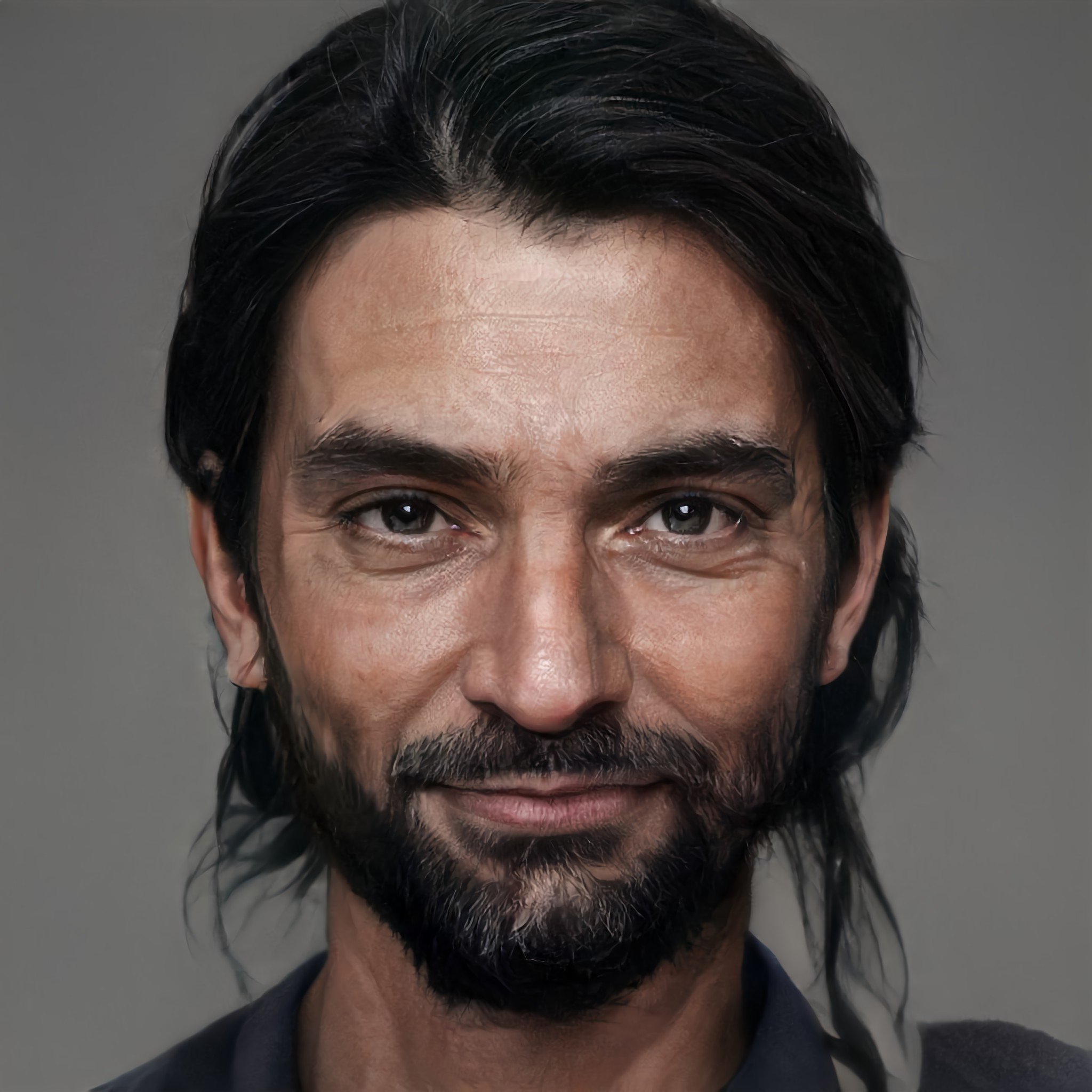
I see him around 5’10”, thin, and dressed in medieval aristocratic clothing with knee-high boots and a long jacket with internal pockets; he wears a belt with leather pouches for spell components.
He’s a wealthy aristocrat, a privileged son of the City State of Brigantia; since his bills are paid and lives a comfortable life, he spends his time studying and teaching at Pax Arcana.
He's a falconer, like most high-town men of Brigantia.

I see him as optimistic and scholarly, intensely interested in mysteries and puzzles. In fact, I see him as a perpetual student, always learning. He made his first appearance as Bartram Humblefoot’s sidekick in the original Aevalorn Tales.
I foresee his stories being clever puzzles where I take the reader down a rabbit hole of evidence and suspicion. In YA stories, he’s a Hardy Boys/Scooby Doo kind of guy. I also see him as a part of any one of my characters’ stories, but Bartram Humblefoot in particular.
Finally, I had some wacko idea that I might make a younger version of him and write some young adult fantasy, but I really haven’t worked that out yet. That’ll evolve over time.
Oh, look! A younger version! It’s almost magic.

Who is Kindle Muckwalker?
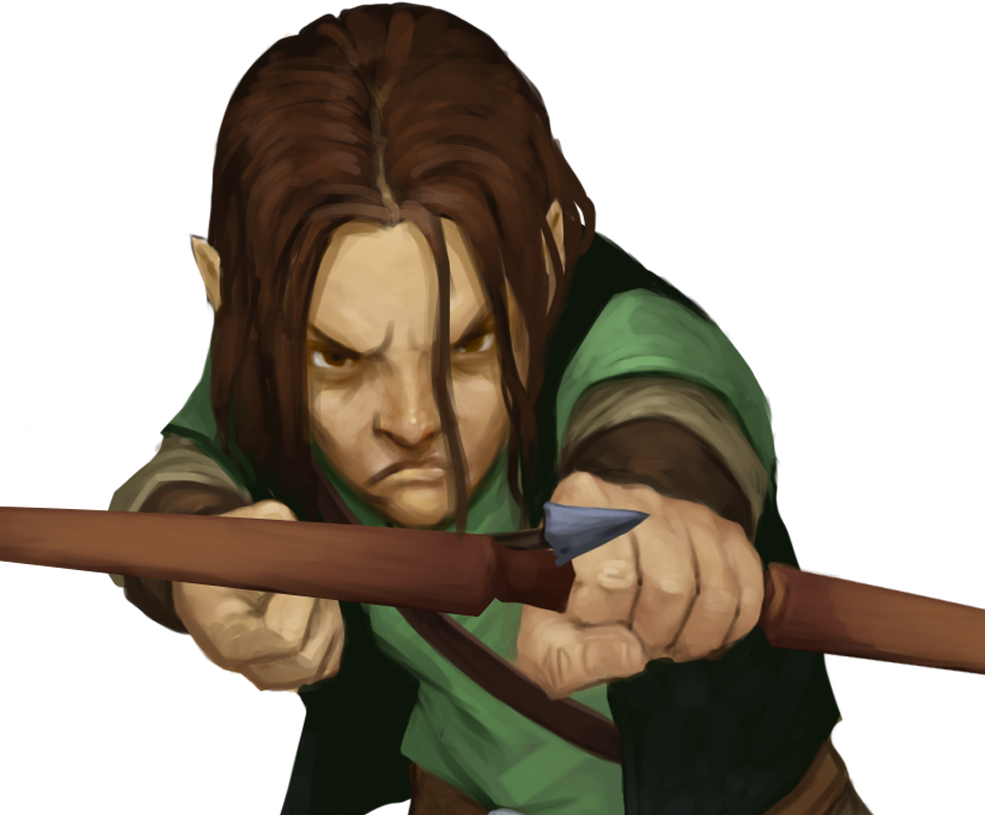
Kindle Muckwalker is a Halfling Ranger of the Aevalorn Parishes.
He’s an outdoorsman, a hunter, a guide; a detached character who is an anathema to most Halfling archetypes because he’s not about hearth and home, or gregarious, or particularly cheerful. He’s a gruff, focused character, with a direct sense of communication, heavily accented, and is generally considered quite peculiar by most Halflings.
He’s got slick greasy straight hair to his shoulders, parted down the middle; pointed chin; I often describe him as grimy, but with no stubble though because he’s a Halfling. He relies on a shortbow for a weapon and wears a quiver of 10 arrows on his back. He's got a hunting knife at his side, secured by the leg, and by the waist. And he has a thick leather belt and leather breeches to his knees.
Stories with Kindle are about leading humans through the Aevalorn Wilds. They’re gritty adventure stories with a splash of nature wrapped in there somewhere. I see Kindle and Jayleigh Warmhollow as companions in some way - with Kindle being a mentor-like character to Jayleigh - where I can introduce more heart and mysticism into his stories.
His first appearance was in The Pig King.


Who is Joliver Barleywood?
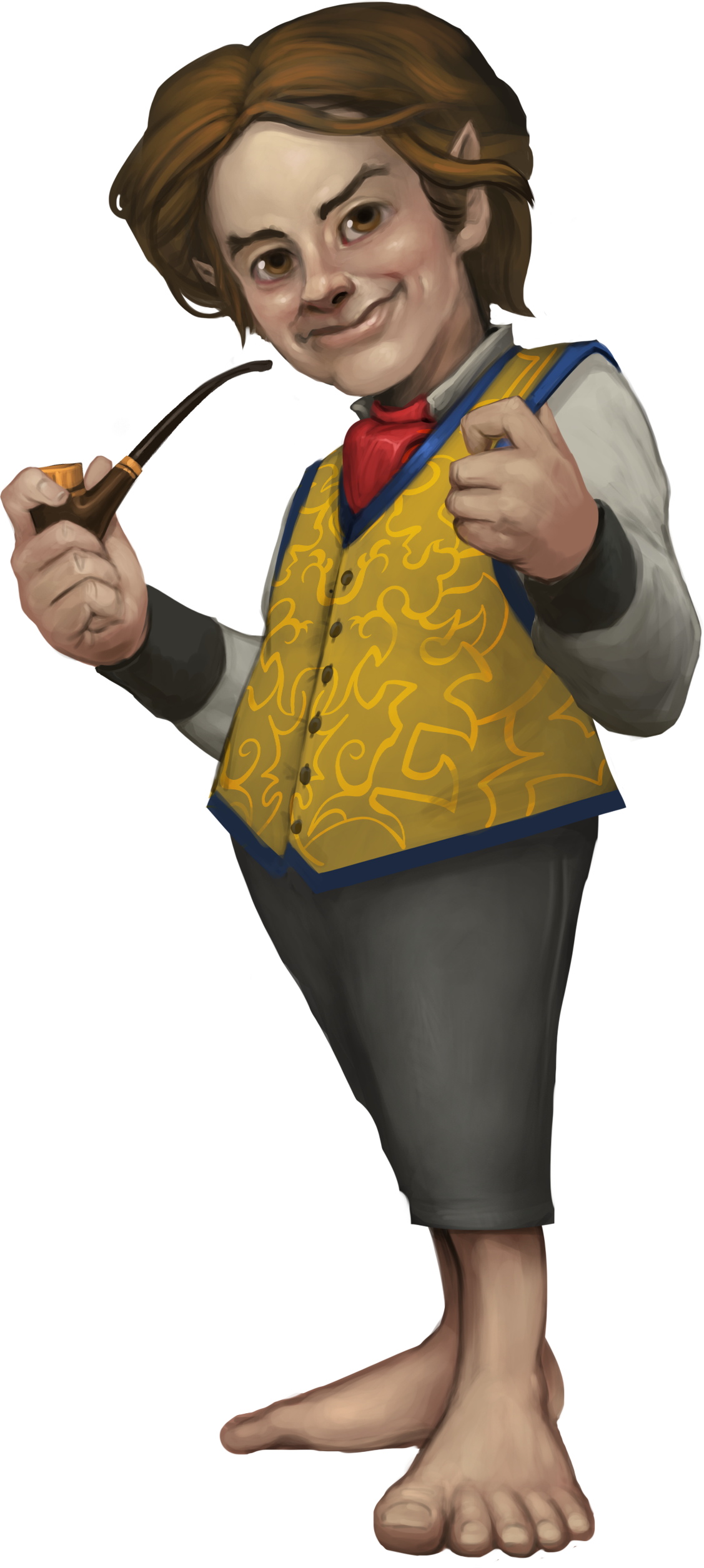
Joliver Barleywood is a Halfling Bard of the Aevalorn Parishes. I picture him as middle-aged, fit, dressed always in a waistcoat and smoking a pipe.
Like Bartram Humblefoot, I picture this character rarely returning to the Parishes, preferring instead to be abroad and amongst Man in Gaelwyn.
This is a character who is interested in stories. I’m trying to make it a point where he’s always asking, “Tell me your tale”, or “Tell me about this or that”. He is a curator of stories; a collector of people’s experiences and dreams.
I want to write Joliver so that he exists somewhere legend and reality. He’s a wandering type, magical; he shows up in time to hear the last words of a dying man, witness an important event, or tell a story when it needs to be heard.
He’s jovial (“Joliver”), playful, teasing, and maybe a little bit snarky when he’s not performing. In D&D terms, he’s a Bard of the College of Lore, a jack of all trades, and a storyteller that holds his audience spellbound.
When I first introduced this character, he was retelling The Ballad of Skyer Dannon; Love’s Repast was his first stand-alone story.


What is a Book?
As an author, technology professional, and digital native, I think it’s beyond time to ask ourselves what a book is, and how technology has broadly transformed the business of publishing.
What we traditionally identify as a book is a certain dimension and size; something that was physical and has pages that we manually flip through to read in consecutive, sequential order; that it has a spine; it has a cover and a jacket, requiring layout designers, typographers, and visual artists.
Because books were physical, there needed to be a process to edit it and make sure it was right. Errors and omissions couldn’t be corrected in the finished product.
In order to make a profit off the product of a book, it had to be economical to produce it. There had to be at least x-number of pages printed under certain constraints to make y-amount of profit. Historically, the profit motive is what filtered writers from being published at all. Publishers knew that, in order to make a profit off a book, there was a formula associated with the cost of production, requiring a minimum and a maximum number of physical pages, in specific dimensions and materials (paperback vs hardcover, for instance).
In order to sell the book, marketers knew that there was a formula that worked: a strong character-driven story with a three-act structure with lots of escalating, high-stakes action, in regards to a fantasy novel, for instance. They knew that a man had to write it; the fantasy demographic repelled female authors. They knew that the protagonist must be a human male to best identify with the reader, and in particular, a white human male. They knew it needed a splashy cover and vivid colors, and it needed to be between x-number of pages, otherwise, a segment of the market wouldn’t be interested in it.
Publishers knew how many units they needed to produce and sell in order to make a profit off the volume. Thus, they made exclusive arrangements for marketing and distributing a book. These exclusive arrangements allowed for a certain amount of time a book sat on shelves, and was calculated from the amount of loss they’d suffer if they didn’t churn the inventory quickly enough. In most cases in the latter half of the 20th century, publishers had to buy-back underperforming books from the retailer and eat their losses.
Authors of traditional books were disconnected from their readers because they had no way to speak to them at scale without the marketing muscle of the publisher.
And physical books suffered a long-tail problem: they’d need to be taken into the storeroom within eight weeks or so to make more room on physical shelves for more product, physically leaving the consumer’s sight and imagination. Only books at the forefront of the consumer’s attention and imagination are what sold; anything else in a store room or warehouse was inaccessible by the consumer.
Therefore, up to the year 2010, there was a lot of gatekeeping that went on in the publishing industry. Fantasy books were costly to produce, expensive to distribute, must meet a slew of criteria to be successful, and excluded female authors and protagonists that didn’t mirror their readers. Authors couldn’t cultivate their own marketing relationship with consumers, and books had an eight-week lifecycle at most.
Throughout the 20th century, those filters, the sheer risk of publishing a book, generated mountains - continents - of rejection letters because, if we’re to be honest, who’d want to be a publisher anyway? Tons of costs, lots of risk, and tiny profits. Publishing sucked as a business model, and retail wasn’t any better. Only scale made money; i.e., Barnes & Noble killing traditional booksellers - remember that?
So what happened in 2010?
Around 2010, a number of factors converged to destroy traditional publishing.
The Internet had created a generation of consumers prepared to consume electronic content;
Broadband - fast, inexpensive Internet access had been brought to most of the industrialized world, and used routinely by lower-middle-class consumers;
The arrival of viable tablet-based computing platforms, allowing one to reasonably hold an electronic copy of a book in facsimile to a traditional book;
Electronic distribution platforms for booksellers allowed retailers to produce print-on-demand products, build electronic products on their platform, and resell and distribute digital media at scale;
Social media allowed authors to disintermediate the publisher and talk directly to consumers, to build their brand as an individual;
The proliferation of secure, nearly costless, Internet-based payment systems enabling an author to sell directly to consumers.
These influences are ongoing and erode the power and profitability of traditional publishing. Very soon, the traditional publishing world will be reduced to just a few players for, in a world where you make < 5% on printed products, scale is everything. M&A like Penguin Random House and Simon & Schuster must happen, otherwise, there is no scale, only efficient competitors, eroding each other’s market share and driving prices to the bottom; nobody will make money, and there will not be any more traditional book publishing business. It simply costs too much and there’s no money in it. If consumers don’t mind paying a premium for a book ($30/unit vs, say, $10/unit electronically), then not a problem. I’d be willing to bet, though, that sentiment will not last, no matter how people like the physical feel of a book in their hands.
So, what is a book?
Today, it a book is digital media - it’s an electronic product.
A book can be created by anyone with a computer.
Books are software. They can be edited and changed at any time, providing instant updates, and released through versioning - just like software.
Authors can grab an ISBN directly electronically; they can manage their own catalogs and meet reseller requirements for inventory and distribution; they can print-on-demand, doing one-off unit-based printing at practically zero cost to them, eroding maybe 2% of their margin.
An electronic book can be distributed at zero cost to anyone, anywhere, in the world, and run off any digital device. There is world-wide distribution of a book at zero cost with no licensing intermediary eroding your margin.
It doesn’t matter what size a book is - how many pages or words; in this case, size doesn’t matter. The costs of production and distribution are exactly the same. A book can be replicated a zillion times at no cost.
The longtail is overcome by filters, social media, and search. Consumers can dig into catalogs with millions of titles and find what interests them, and social media can help market titles to new readers.
A book can be marketed directly to consumers by authors, allowing them to make their own brands and relationships. No longer does a publisher get to intermediate that relationship, allowing anyone, anywhere, to create a following of readers.
Its typesetting doesn’t matter. The consumer, not the publisher, can choose their own preferences for typeface on their digital readers.
In an electronic format, books are extensions of digital assistants like dictionaries, thesauruses, note taking and research/citation tools, and Internet search. A single in-narrative click can help inform a reader or lead them to more engagement with the author online.
Editing and art assets are increasingly cheap - most of that labor can be outsourced using Internet based freelancing - allow authors to access quality talent at increasingly lower costs. And one day, AI-generated imaging will offer authors free high-resolution artwork at zero cost.
The development and publishing of a book is highly automated. If you can learn how to press a couple of buttons, you can move data between - what used to be - complicated formatting changes.
In essence, the author is their own publisher, editor, and marketer, and they have direct access to the market and consumers from which to create and maintain their brand. This is simply the dream of authors like Richard Brautigan - we are all publishers.
I am fortunate enough to live in an amazing time of transformation in this industry. The nature of what a book is has radically been transformed.
I generally write short stories (~10,000 words) and distribute them world-wide at no cost, about characters and settings that’d usually be gateway’d out by traditional publishers. But with today’s model, I can write and distribute anything of any size. Who’d want to read novellas about Halflings anyway? Well, I’m lucky enough to just do my own thing and improve my art to connect with audiences and build my own brand. What an amazing time!
The era of waiting around for someone to validate you as an author with an acceptance letter is over. You are an author; you are a publisher. Even traditional publishers vet authors based on their skillsets in developing their own work - they’re more likely to hire someone who comes in with an audience of 10,000 readers and an established catalog of content, than someone who doesn’t already have it. Why put a risky bet on someone who can’t do it themselves?
Even as I write this, though, I’m very much aware that another transformation is in play concerning AI (Artificial Intelligence). In the very near future, most of what readers consume will be written by automation - computers trained on writing specific forms of content, creating amazing works of art that will compete with even the best of us human authors. So the ability to be seen, hired, read, and compensated as an author will continue to meet headlong forces. I write because I like telling stories; not because I think I’ll make any money at it, and that concept of making money is probably unrealistic.
In a world where computers produce written content, only a miniscule percent of authors will actually make money in this business. True talents will own their own brand, disintermediate publishers and booksellers, and go directly to their audience, who will circulate their work in social media as to attract new readership; all the while, they’ll be under constant threat from AI that can emulate their unique style at a drop of a hat.
What is a book? And what is an author? Well, both are rapidly changing.
Take advantage of change. You, as an author, no longer need to wait around for someone to tell you you’re good enough. That’s crap - go publish now! And publish every day.
Thanks for reading my work.
R